
Unicorns and Space: Magical Elements in Exploration

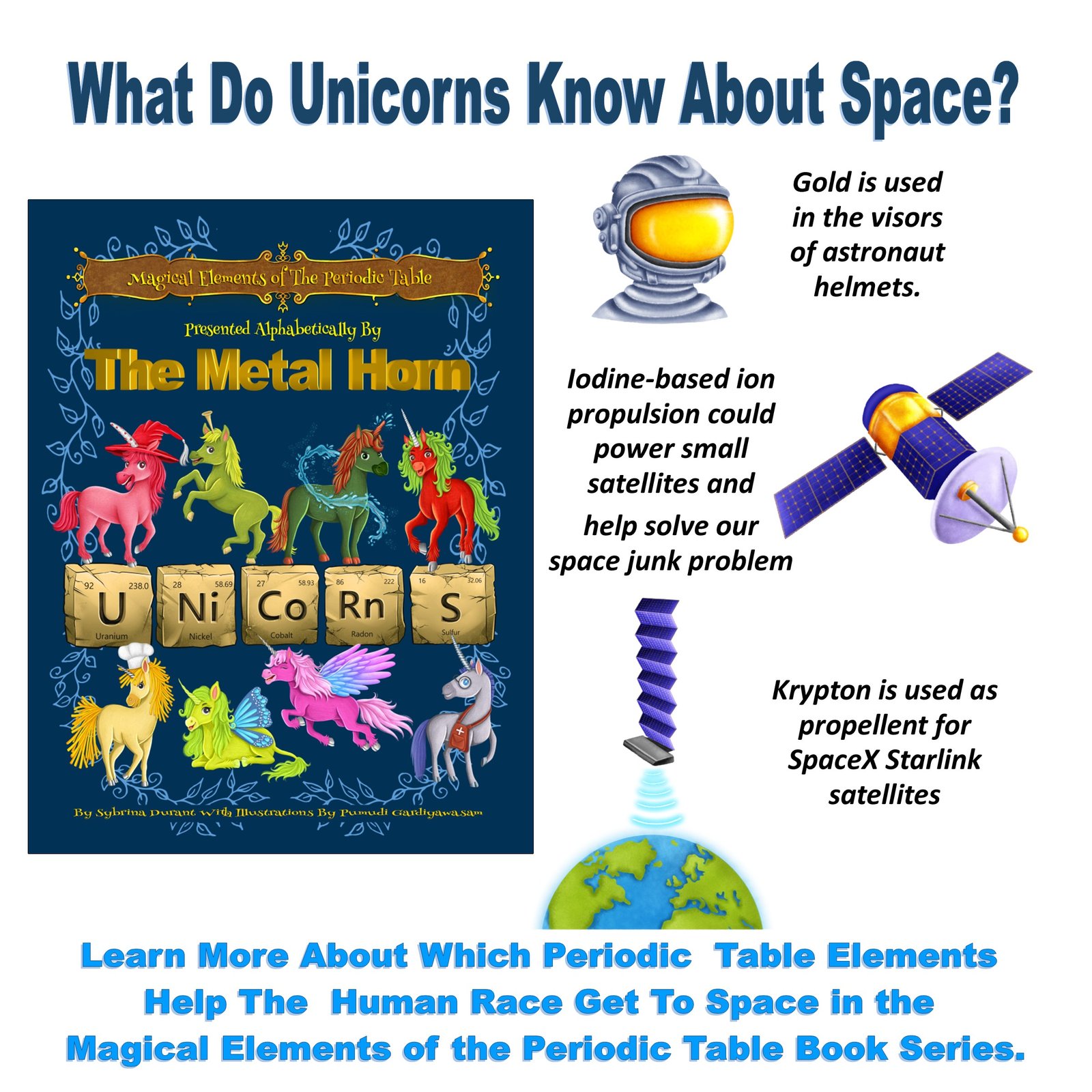
If unicorns were to take a tour of modern space technology, they might be most enchanted by this: space exploration is full of rare, brilliant, and surprisingly magical elements. From shining helmet visors to satellite propulsion systems, the periodic table plays a quiet but essential role in helping humans explore beyond Earth.
Gold, for example, is used in the visors of astronaut helmets. Its thin coating helps reflect harmful solar radiation while still allowing astronauts to see clearly. In a way, gold acts like a tiny shield of sunlight-fighting magic, protecting explorers as they travel through the harsh environment of space.
Some elements are helping to solve one of the biggest challenges in orbit: space junk. Iodine-based ion propulsion is an emerging technology that could power small satellites more efficiently and potentially help reduce orbital clutter. Because it can be used in compact propulsion systems, iodine may help future spacecraft maneuver better and avoid becoming part of the debris problem.
Krypton, another noble gas, has already found a role in space. SpaceX uses krypton as a propellant for Starlink satellites, showing that even a relatively rare gas can help large satellite networks stay positioned in orbit. Meanwhile, rubidium can be used in ion propulsion powered space probes, helping deep-space missions travel farther using efficient, low-thrust systems.
The space industry also relies on many other elements in ways both big and small. Some support structures, some protect equipment, and some help power, guide, or insulate spacecraft. Here’s a quick look at several more elements that may be used in space-related applications:
Aluminum — Lightweight and strong, aluminum is widely used in spacecraft frames and satellite structures.
Copper — Excellent for electrical wiring and heat transfer in spacecraft systems.
Dysprosium — Used in high-performance magnets and specialized space materials.
Erbium — Important in fiber-optic technology and advanced communication systems.
Fluorine — Found in some rocket propellants and high-performance chemical compounds.
Holmium — Used in specialized magnets and scientific instruments.
Iron — A major part of strong alloys used in spacecraft and launch systems.
Lead — Used for radiation shielding in certain space-related equipment.
Magnesium — Lightweight metal used in alloys where reducing mass is critical.
Nickel — Used in heat-resistant alloys and spacecraft components.
Osmium — Extremely dense and rare, sometimes used in specialized high-wear applications.
Potassium — Found in certain scientific instruments and chemical systems.
Mercury — Historically important in instruments and propulsion research, though used cautiously today.
Silver — Excellent conductor, often used in electronics and reflective coatings.
Tin — Used in solder and electronic assembly for space hardware.
Uranium — Used in some deep-space power systems and scientific applications.
Vanadium — Added to strong alloys for durability and high-temperature performance.
Tungsten — Valued for its extreme heat resistance and use in high-temperature parts.
Xenon — A common ion propulsion propellant for spacecraft.
Ytterbium — Used in some advanced optical and laser systems.
Zinc — Useful in alloys, coatings, and corrosion protection.
Space may seem magical, but much of that magic comes from the clever use of elements—each with its own special properties. Whether it’s gold protecting an astronaut, krypton pushing a satellite, or xenon powering a probe, the periodic table is one of humanity’s most important tools for exploring the cosmos.
Learn more about all of the elements in the Magical Elements of the Periodic Table Book series at magicalptelements.com.